Morning Glory
Bullet TrainMorning Glory, known as the Pusher, turns the ordinary movements of a crowd and the timing of traffic into instruments of murder. He studies people at a crossing, waits for a moment when a vehicle will be moving fast, and nudges a target into its path. Yet the same character is later tasked with protecting Wataru in a hospital. His work remains violent, but the shift in whom he is asked to target exposes a tension between his professional coldness and the vulnerable life he is meant to defend.
Identity and Method
Morning Glory is presented as a paid operator who can act as the Pusher’s representative when a prospective client seeks his services. The title suggests a hidden force blamed for inexplicable injuries: people describe a sudden cut as the work of the Japanese weasel spirit kamaitachi, though Morning Glory rejects the idea that the wind itself causes the wound. In the woman’s analogy, the Pusher is likewise a made-up explanation for a person being struck by a car or jumping in front of a train. Morning Glory turns that account inside out. The apparent accident is not a legend; someone has made it happen.
His method relies on close observation rather than spectacle. At an intersection, he stands thirty metres from a chain bookstore and watches both the traffic light and the pedestrians crossing in different directions. He memorizes the signal’s timing, particularly the interval when the light changes toward red. In his calculation, drivers accelerate at yellow, abandoning caution and charging through. The crossing becomes a mechanism he can study: pedestrians provide cover, the signal supplies a narrow opportunity, and traffic supplies the force.
The Intersections
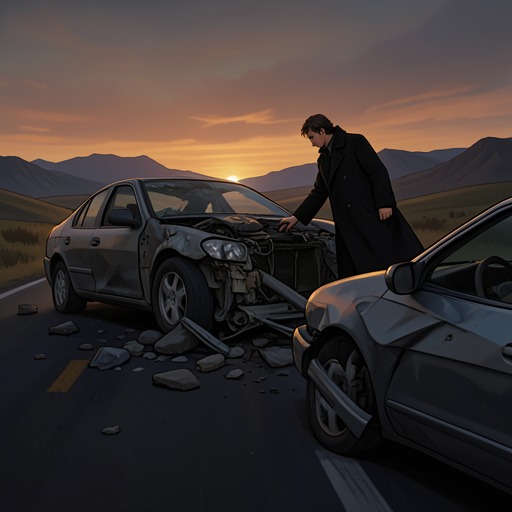
The first described killing begins as a proposed job. A woman approaches Morning Glory seeking to hire him and questions the Pusher’s existence, pressing for details instead of accepting his explanation. He dislikes her and refuses the job. When she stubbornly follows after him, he pushes her into the road just as the light is about to turn red. A pickup truck barrels through and smashes into her. His sole regret is that he has done it for no fee. The detail makes the violence more than professional routine: he kills not to complete the job she sought to commission, but because he wants to silence an unwelcome question, and then measures the act by its lack of payment.
A later operation repeats the intersection’s lethal geometry with a different target. Morning Glory scans passers-by, dismissing them by quick descriptions until a short, broad-shouldered man in his forties, wearing a pinstriped grey suit, catches his attention. He follows the man into the crowd waiting for the signal. When the light changes from green to yellow, the target stops at the edge of the crossing. A black minivan passes, and the timing is off; the next car happens to be the same type. As the light changes, the vehicle surges forward. Morning Glory casually touches the man’s back. The impact and the screeching tyres break the crowd’s stillness into collective shock.
The scene does not present Morning Glory as an exhilarated killer. As he follows the second man, he is aware of his surroundings and present in the moment, but feels as though he is not quite directing his own movements. After the collision he walks back the way he came, fluidly, while cries for an ambulance rise behind him. His heart remains calm, like an undisturbed lake. What comes to mind is not the injured man or the people left at the crossing, but the vague recollection that he once carried out a job at the same intersection. The return to a familiar location makes the killing feel repeatable: the setting is part of a procedure he can enter, perform, and leave.
The Hospital Assignment
Later, a phone call finds Morning Glory beside a dandelion and a ladybug, outside the hospital where Wataru lies unconscious and dependent on life support. His attention to the small insect opens a contrast with his work. He recalls children he once encountered on a job who collected insect trading cards; they must now be teenagers. Time, he thinks, rushes on for other people while he remains still, alone, as if clinging to a boulder in a current. The thought gives his waiting a personal dimension without making him less isolated.
The call brings that stillness into contact with an immediate danger. Shigeru Kimura, the intermediary on the phone, has asked him to check on his grandson in a particular hospital room. Morning Glory goes there and sees a man in a white coat enter and operate the life-support machine. Hidden under the bed, among the cords, plugs, and wires, he cannot identify the man by his face. Instead, he notices that the man’s shoes are dirty and stained with mud, an incongruity that makes him suspect the visitor is not what he appears to be. Morning Glory reports what he saw; Shigeru Kimura confirms that the man is the person he is looking for.
The assignment is protection, but its terms are explicit. Shigeru Kimura says that if anyone tries to hurt the boy, Morning Glory is to show no mercy. Morning Glory reflects that allowing the suspected attacker to escape might not matter if the boy is protected. The intermediary insists on the instruction, and Morning Glory accepts the job. Outside, the man with a white bundle looks from side to side, crosses toward a traffic island, and passes Morning Glory, who again notices the mud on his shoes. The man then waits for the light to change and takes out a phone. The evidence ends with Morning Glory having accepted the assignment and recognized the target; it does not establish what he does next.
Relationships and Narrative Significance
Morning Glory’s connection to Shigeru Kimura is professional, mediated by a phone call and a specific request. Shigeru Kimura’s instructions originate in concern for his grandson: before leaving for Mizusawa-Esashi to catch the Shinkansen, he asked his friend to check on Wataru, protect him, and show no mercy to anyone suspicious. He had no mobile phone and proposed using a Shinkansen payphone, but Shigeru Kimura pointed out that those phones no longer accepted incoming calls and promised another means of contact. The exchange frames Morning Glory’s hospital assignment as part of a protective plan assembled at a distance, rather than a chance encounter.
The contrast between the intersection killings and the hospital watch defines Morning Glory more sharply than either role alone. He is capable of engineering a collision with a casual touch, leaving the scene calm and recalling a previous job at the same place. He is also capable of noticing a tiny creature’s labor and imagining that its flight might lighten a witness’s sadness. He calls that possibility the opposite of his work: every time he pushes someone, he darkens the world. That reflection does not undo the violence or amount to repentance; it shows that he understands the moral direction of his actions. In the hospital sequence, the task is to keep harm away from Wataru, but the means offered by Shigeru Kimura remain the same merciless violence that has made Morning Glory the Pusher.